
UAE E-Invoicing 2026–2027: Latest Implementation Dates, Deadlines and Compliance Guide
The UAE is moving towards a structured electronic invoicing system as part of its wider digital transformation and tax-compliance framework. Businesses operating in the UAE should understand the new e-Invoicing requirements, implementation dates, Accredited Service Provider (ASP) requirements and the changes that may be needed to their accounting or ERP systems.Advises can be sougt from reputed consultants.
The UAE Ministry of Finance has published official e-Invoicing guidance covering the scope, implementation approach, technical requirements, service providers and business-readiness steps. The Ministry also states that its e-Invoicing portal is the official source of information for the programme.
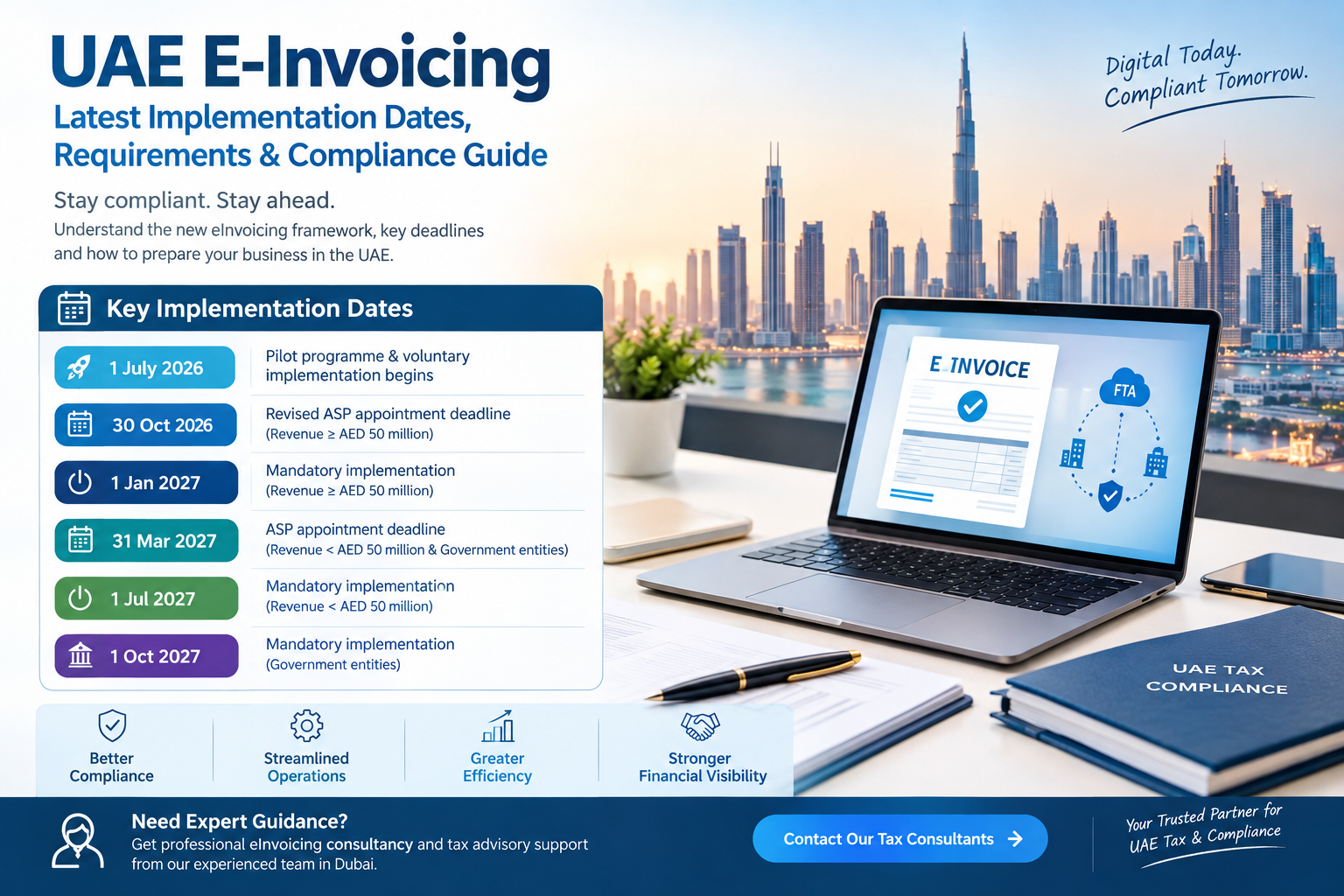
For businesses subject to the first mandatory phase, the key date is 1 January 2027. The Ministry has also extended the ASP appointment deadline for businesses with annual revenue exceeding AED 50 million to 30 October 2026.
Businesses should therefore begin reviewing their invoicing, accounting and technology processes well before their applicable implementation date.
What Is UAE E-Invoicing?
UAE e-Invoicing is a structured electronic exchange of invoice data between a supplier and a buyer, with relevant data reported electronically to the UAE Federal Tax Authority.
It is important to understand that an e-Invoice is not simply a PDF invoice sent by email.
The UAE Ministry of Finance specifically states that PDFs, Word documents, images, scanned invoices and invoices sent by email are not considered e-Invoices under the UAE system.
The system is designed around structured electronic invoice data that can be exchanged and processed through the prescribed e-Invoicing framework.
Consider Best Tax Consultant in U.A.E
Why Is the UAE Introducing E-Invoicing?
The UAE e-Invoicing programme is intended to support greater digitalisation, efficiency, transparency and tax compliance.
According to the Ministry of Finance, the system is designed to reduce manual intervention in invoicing and tax-reporting processes, improve operational efficiency and support more streamlined exchange of invoice information.
For businesses, the transition may also create an opportunity to improve:
- Invoice processing
- Accounting automation
- Data accuracy
- Financial reporting
- Tax-data management
- Internal controls
- Digital record keeping
- Integration between accounting and ERP systems
The Ministry’s official model uses Accredited Service Providers to facilitate electronic invoice exchange and reporting.
Who Is Covered by UAE E-Invoicing?
The UAE e-Invoicing framework is being introduced for persons conducting business in the UAE in respect of transactions within scope, subject to specific exclusions.
The framework covers relevant business-to-business (B2B) and business-to-government (B2G) transactions, with certain transactions and activities excluded under the applicable rules.
Businesses should therefore assess their individual circumstances rather than assuming that every invoice or transaction will automatically fall within exactly the same requirements.
The Ministry’s guidelines provide specific exclusions, including certain sovereign government activities, specified airline services and certain exempt financial services.
UAE E-Invoicing Implementation Timeline 2026–2027
The UAE implementation is being introduced in phases.
1. Pilot Programme — From 1 July 2026
The UAE e-Invoicing Pilot Programme commenced from 1 July 2026 for selected participants.
The Ministry states that selected persons are contacted regarding participation and must agree in writing to participate in the Pilot Programme.
2. Voluntary E-Invoicing — From 1 July 2026
Businesses can also voluntarily implement e-Invoicing from 1 July 2026, regardless of their revenue, subject to the applicable technical requirements.
3. Mandatory Implementation
The mandatory implementation dates are phased according to the applicable category.
| Business / Entity | ASP Appointment Deadline | Mandatory E-Invoicing |
|---|---|---|
| Businesses with annual revenue exceeding AED 50 million | 30 October 2026* | 1 January 2027 |
| Businesses with annual revenue below AED 50 million | 31 March 2027 | 1 July 2027 |
| In-scope Government Entities | 31 March 2027 | 1 October 2027 |
*The Ministry announced in May 2026 that the ASP appointment deadline for persons subject to the system whose annual revenues exceed AED 50 million was extended from 31 July 2026 to 30 October 2026. The mandatory implementation date remains 1 January 2027.
The underlying official implementation guidance sets out the phased dates for businesses below AED 50 million and government entities.
What Is an Accredited Service Provider (ASP)?
An Accredited Service Provider, or ASP, is an approved service provider that supports businesses with the technical processes required for UAE e-Invoicing.
Businesses should evaluate an ASP based on factors such as:
- Technical compatibility
- Accounting and ERP integration
- Data security
- Implementation support
- Reporting capabilities
- Transaction volumes
- Pricing
- Customer support
- Scalability
- Relevant business requirements
The UAE Ministry of Finance maintains an official e-Invoicing portal containing information about Accredited Service Providers and the programme.
How Does UAE E-Invoicing Work?
The UAE framework uses a decentralised electronic invoicing model in which Accredited Service Providers facilitate the exchange and reporting of invoice information.
In broad terms:
- The supplier prepares structured e-Invoice data.
- The supplier’s ASP receives and validates the data.
- The e-Invoice is transmitted through the prescribed electronic network.
- Relevant tax data is reported to the Federal Tax Authority.
- The buyer receives the electronic invoice through its ASP.
- Validation and status information is exchanged between the relevant parties.
The Ministry’s official e-Invoicing portal describes the flow of invoice data between suppliers, ASPs, buyers and the tax authority.
What Is the Difference Between an E-Invoice and a PDF Invoice?
This is one of the most important points for UAE businesses.
A PDF invoice may be generated electronically, but that does not automatically make it an e-Invoice under the UAE framework.
For example:
Traditional invoice:
Company creates PDF → emails PDF → customer downloads PDF
UAE e-Invoice:
Structured invoice data → Accredited Service Provider → electronic exchange/reporting → buyer
The Ministry specifically confirms that PDFs, Word documents, images, scanned copies and emails are not e-Invoices.
Businesses should therefore review whether their current invoicing process can produce and transmit the required structured data. Also, conUAE.sider Best Tax Consultancy in the
How Should UAE Businesses Prepare for E-Invoicing?
Businesses should not wait until their mandatory implementation date to begin preparation.
A practical preparation process can include the following steps.
1. Review Your Current Invoicing Process
Identify:
- How invoices are created
- Where invoice data is stored
- How invoices are sent to customers
- How credit notes are processed
- How invoices are recorded in accounting software
- How VAT data is extracted
- How customer and supplier information is maintained
This review helps identify potential gaps between the existing process and the e-Invoicing requirements.
2. Review Your Accounting or ERP System
Your accounting or ERP system may need to exchange structured invoice data with an Accredited Service Provider.
Businesses should check:
- Software compatibility
- API capabilities
- Customer master data
- Supplier master data
- VAT information
- Invoice numbering
- Credit-note processing
- Integration capability
- Data export/import functions
The Ministry’s readiness guidance specifically recommends identifying changes required in accounting, ERP and invoicing systems.
3. Select an Accredited Service Provider
Businesses subject to the applicable ASP requirement should select an appropriate Accredited Service Provider and complete the required onboarding process.
The official guidance indicates that onboarding with an ASP is initiated by the business or government entity through EmaraTax, followed by selection and onboarding with the ASP.
4. Test Your E-Invoicing Process
Before going live, businesses should test:
- Invoice creation
- Data transmission
- Customer information
- VAT information
- Credit notes
- Invoice validation
- Error handling
- Reporting
- Accounting integration
Testing can help identify technical or data-quality issues before mandatory implementation.
5. Train Your Finance and Accounts Team
E-Invoicing is not only an IT project.
Finance and accounting teams should understand:
- New invoice procedures
- Required data
- Credit-note procedures
- Error correction
- ASP communication
- Record keeping
- Approval processes
- Tax compliance implications
Training can help reduce errors during implementation.
What Data Should Businesses Review?
Businesses should review the quality and completeness of their master data.
Important areas can include:
Customer Data
- Legal name
- Tax registration details where applicable
- Address
- Contact information
- Identification information required by the applicable specification
Supplier Data
- Legal name
- Tax details
- Address
- Supplier identification
- Payment information where relevant
Invoice Data
- Invoice number
- Invoice date
- Supplier details
- Buyer details
- Description of goods/services
- Quantity
- Price
- VAT information
- Total amount
- Credit-note information where applicable
The precise mandatory fields depend on the relevant invoice type and technical requirements. The Ministry’s guidelines point businesses to the applicable UAE and PINT-AE specifications.
What Are the Benefits of UAE E-Invoicing?
E-Invoicing can provide businesses with opportunities to improve their financial processes.
Potential benefits include:
Faster Invoice Processing
Structured invoice information can reduce manual data entry and processing.
Better Data Accuracy
Automated validation can help identify errors before invoices move through the process.
Improved Financial Visibility
Structured invoice data can make financial information easier to analyse.
Better Integration
E-Invoicing can connect invoicing, accounting, ERP and tax-reporting processes more efficiently.
Improved Compliance Management
Electronic reporting can support more systematic tax-data management.
Reduced Paper-Based Processes
Digital invoicing can reduce dependence on paper-based documentation.
The Ministry identifies digitalisation, efficiency, improved financial visibility, security and simplified compliance among the objectives and potential benefits of the e-Invoicing programme.
Common Mistakes Businesses Should Avoid
Businesses preparing for e-Invoicing should avoid leaving implementation until the final weeks.
Common preparation issues include:
- Assuming a PDF invoice is an e-Invoice
- Not reviewing accounting software compatibility
- Delaying ASP selection
- Incomplete customer or supplier data
- Not testing integrations
- Not reviewing credit-note processes
- Failing to train finance staff
- Ignoring data-security requirements
- Not establishing an internal implementation plan
A structured readiness assessment can help businesses identify these issues before going live.
UAE E-Invoicing: Practical Business Checklist
Use this checklist to assess your current readiness:
☐ Determine your applicable e-Invoicing implementation date
☐ Review whether your transactions are within scope
☐ Review current invoicing procedures
☐ Review accounting/ERP software
☐ Clean customer and supplier master data
☐ Assess integration requirements
☐ Review Accredited Service Provider options
☐ Complete ASP onboarding where applicable
☐ Test invoice exchange
☐ Test credit-note processing
☐ Test tax-data reporting
☐ Train finance and accounting employees
☐ Establish error-resolution procedures
☐ Prepare internal controls
☐ Complete implementation before the applicable deadline
UAE E-Invoicing Frequently Asked Questions
What is UAE e-Invoicing?
UAE e-Invoicing is a structured electronic exchange of invoice data between suppliers and buyers, with relevant information reported electronically to the UAE Federal Tax Authority. PDFs, Word documents, images, scanned invoices and email attachments are not considered e-Invoices under the UAE system.
When will UAE e-Invoicing become mandatory?
Mandatory implementation is phased. Businesses with annual revenue exceeding AED 50 million are required to implement the system by 1 January 2027. Businesses below AED 50 million are scheduled for mandatory implementation by 1 July 2027, while in-scope government entities are scheduled for 1 October 2027.
What is the latest ASP appointment deadline for businesses above AED 50 million revenue?
The UAE Ministry of Finance extended the ASP appointment deadline from 31 July 2026 to 30 October 2026 for persons subject to the system whose annual revenue exceeds AED 50 million. The implementation deadline remains 1 January 2027.
Can businesses voluntarily adopt e-Invoicing before their mandatory date?
Yes. The official UAE guidelines state that persons can voluntarily implement e-Invoicing from 1 July 2026, regardless of revenue, subject to the applicable technical requirements.
Does a PDF invoice qualify as a UAE e-Invoice?
No. The Ministry of Finance specifically states that PDFs, Word documents, images, scanned copies and emails are not e-Invoices under the UAE system.
Who needs to use UAE e-Invoicing?
The system applies to persons conducting business in the UAE in respect of transactions within scope, subject to specified exclusions. The framework includes relevant B2B and B2G transactions. Businesses should review the applicable legislation and guidance for specific exclusions.
What should businesses do before the UAE e-Invoicing deadline?
Businesses should determine their applicable deadline, review their invoicing and accounting systems, assess data readiness, select an appropriate ASP where required, complete onboarding, test electronic invoice exchange and reporting, and train relevant employees. The official guidelines outline a readiness process covering requirements assessment, ASP selection, testing and go-live.
Where can businesses find official UAE e-Invoicing information?
The UAE Ministry of Finance e-Invoicing portal is the official source for information about the UAE e-Invoicing programme, including guidelines, legislation, mandatory field requirements and Accredited Service Providers.
Our View: Start Preparing Before the Deadline
UAE e-Invoicing represents a significant change in how businesses will create, exchange and manage invoice information.
The key issue for businesses is not simply replacing paper or PDF invoices. Businesses should assess their accounting systems, ERP systems, master data, internal processes, controls and finance-team readiness.
With mandatory implementation beginning in 2027 and the first major ASP appointment deadline approaching on 30 October 2026 for businesses with annual revenue exceeding AED 50 million, businesses in the applicable category should review their readiness now.
Smaller businesses should also use the available preparation period to assess their systems and processes ahead of the 1 July 2027 mandatory implementation date.
Need Help Preparing for UAE E-Invoicing?
Rebate Advisory can assist businesses with accounting, tax and financial advisory requirements and help them review their readiness for the UAE’s changing digital tax environment.
If your business needs assistance reviewing its accounting processes, tax compliance requirements or e-Invoicing readiness, contact our team for a consultation.